
History – In this article there is the detailed information about Agra Fort – Agra Fort stands as a magnificent historical fortress in the enchanting city of Agra, India. It served as the primary abode for the emperors of the illustrious Mughal Dynasty until the year 1638, when the capital was relocated from Agra to the grand city of Delhi. Agra fort is a the world heritage site of UNESCO, it occupies the area of 2.4 Sq. Kilometre.After the First Battle of Panipat in 1526, Babur, who emerged victorious, made the fort his home, residing in the palace of Ibrahim Lodi. He later added a baoli to the structure. His successor, Humayun, was crowned there in 1530.Unfortunately, he was defeated by Sher Shah Suri at Bilgram in 1540. The Suris maintained control of the fort until 1555, when Humayun successfully recaptured it. In 1556, Hemu, a general under Adil Shah Suri, took back Agra and chased its fleeing governor to Delhi, where he encountered the Mughals in the Battle of Tughlaqabad. Acknowledging the significance of its pivotal location, Akbar chose it as his capital and arrived in Agra in 1558,some historians documented that this was a brick fort known as ‘Badalgarh’. It was in a state of disrepair, prompting Akbar to have it reconstructed using red sandstone from the Barauli region in the Dhaulpur district of Rajasthan. The architects established the foundation, and it was constructed with bricks in the inner core and sandstone on the outer surfaces. Around 4,000 builders worked on it daily for eight years, completing it in 1573.Shah Jahan, the grandson of Akbar, was responsible for the site’s transformation into its current state. He built the exquisite Taj Mahal to commemorate his wife, Mumtaz Mahal. Unlike Akbar, Shah Jahan had a preference for white marble in his architectural designs. He removed some of the earlier structures within the fort to make way for his creations.Shah Jahan was ousted and imprisoned by his son, Aurangzeb, inside the fort. It is believed that Shah Jahan died in Muthamman Burj, an octagonal shaped tower with a marble balcony that provides a sight of the Taj Mahal.
Information About Agra Fort
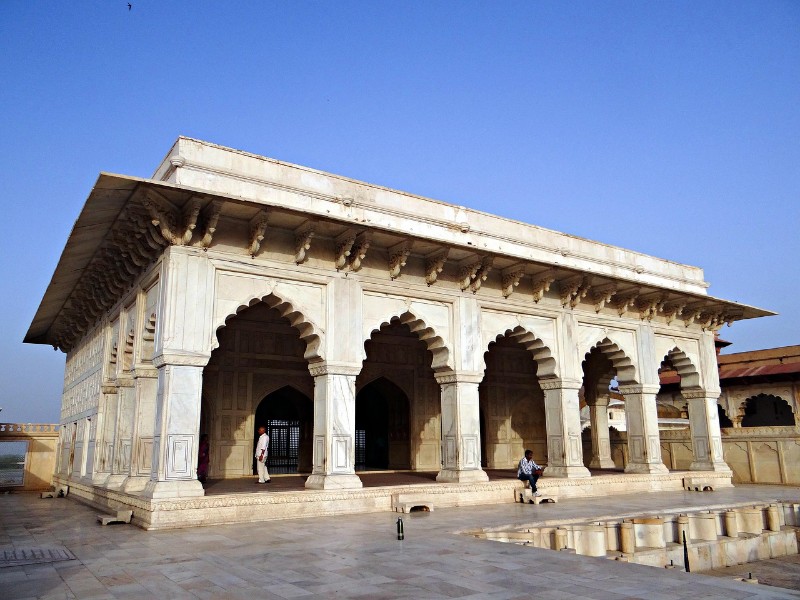
Emblem of Strength: The prominent use of red sandstone in the creation of Agra Fort illustrated the power and splendor of the Mughal Empire. This fort acted as both a royal home and a representation of imperial authority and influence.
Famous palaces – Other significant aspects of Agra Fort include the Sheesh Mahal (Mirror Palace), whose plaster walls and ceilings glisten with inlaid mirrors; the white marble Nagina Masjid (Gem Mosque), which functioned as the private mosque for the royal ladies; the Diwan-i-Aam (Hall of Public Audience), a spacious pavilion featuring colonnades of scalloped arches and a throne room for official receptions and public gatherings; and the smaller Diwan-i-Khas (Hall of Private Audience), where the emperor welcomed visiting dignitaries and aristocrats for state matters.
Architecture– Agra Fort exemplifies Indo-Islamic architecture remarkably, noted for its extensive red sandstone usage, detailed carvings, and graceful design. This fort highlights the architectural excellence of the Mughal Empire under Emperor Akbar and his successors.
Tourist attraction – Agra Fort stands as a prominent tourist destination in India, attracting visitors globally who wish to admire its stunning architecture, delve into its historical background and recognize its cultural importance.
Related Posts
Who Built Meenakshi Temple (Minaxi Mandir)
In Madurai, Tamil Nadu, India, there is an ancient Hindu…

Hill Stations Of Southern India
There are many stunning hill stations of Southern India that…